|
The Thing He Carried
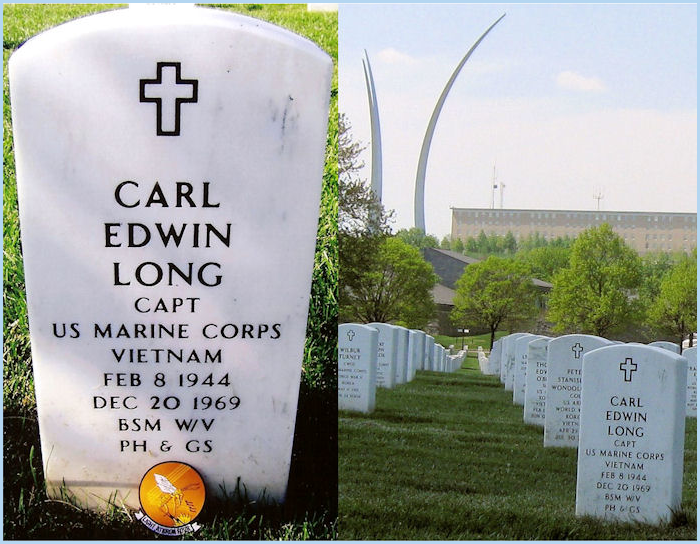
Captain Carl Edwin Long – USMC
Born: Feb. 8, 1944 ~ Died: Dec. 20, 1969, Phuoc Tuy Province, Vietnam
From: College Station, Texas ~ Graduated from Texas A&M University in 1966
Remains Recovered & Returned: Dec. 16, 1992 ~ Remains Identified: May 3, 2004
 Carl Long grew up in Dallas, Texas. After college he joined the United States Marine Corps as a Marine Infantry Officer (MOS 0302). He was wounded & decorated for his actions on his first tour to Vietnam but returned for a second tour with Sub Unit 1 of the 1st Air-Naval Gunfire Liaison Company in 1969.
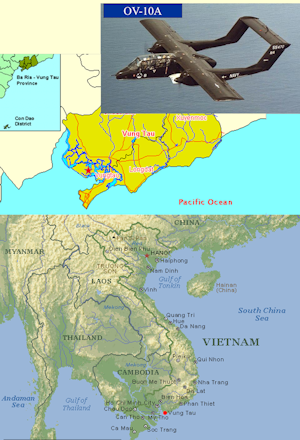
While attached to the “Black Ponies” of Navy Light Attack Squadron 4 (VAL-4), Carl flew daily Reconnaissance and Fire Support patrols over the Rung Sat Special Zone (RSSZ) in Phuoc Tuy Province of South Vietnam. The heart of the Rung Sat Zone was an ugly place. Defoliation had left the riverbanks a barren muddy barrier between the river and the mangrove swamps in the area. But winding through it for 40 miles was South Vietnam’s primary shipping channel, the Long Tau Channel. Several ships a day made the 40 mile journey between the South China Sea and Saigon carrying supplies and they all needed protection from the North Vietnamese and Viet Cong enemy forces that had long hoped to sink a large ship somewhere along the channel in an attempt to block ship movement up and down the river for several months. The SU-1 ‘Spotters’ were just a small part of the wide variety of United States and Vietnamese forces assigned to protect these ships.
VAL-4’s Detachment Bravo stationed at Vung Tau had been flying daily patrols over the Long Tau Shipping Channel for several months since a number of ships had been attacked as they sailed the waters between Saigon and the sea. The OV-10s were equipped with external fuel tanks to increase their flying time, but the enemy rarely fired on the ships while the ‘Black Ponies’ patrolled overhead. The long missions were uncomfortable and somewhat of a waste of assets and in July 1969 the Black Ponies began flying single aircraft patrols over the RSSZ with a Marine Air Observer in the backseat.
Taking off from Vung Tau Army Airfield on a late-afternoon mission over the Rung Sat Zone on December 20, 1969, Carl was flying in the back seat of North American Rockwell OV-10A “Bronco” Bureau Number 155503 piloted by Lt.(jg) Joel Sandberg when their aircraft was shot down.
VAL-4 Detachment Bravo Pilot Lt. Gary “Zoo” Rezeau recalls: "VAL-4's mission objectives in the RSSZ were to detect hidden enemy forces hidden along the Nha Be River, which was a shipping channel from the South China Sea to the Cat Lai port in Saigon.
These enemy forces would use various types of weapons including submerged mines and rocket propelled grenades to attack the cargo ships using the Nha Be River. The Rung Sat Special Zone was the river delta area of the Nha Be River. The main channel of that river runs along the west side of the delta area, and the entire delta was completely defoliated using Agent Orange so as to limit the cover available to the enemy forces.
Our tactics were to either call in naval gunfire from off shore US Navy destroyers, if available, call in artillery fire from fire support bases if in range, or call in air support to attack the enemy. We also carried ordnance which we would use to attack the enemy. It was a mission that required both of us to keep a keen eye on the banks of the river to try to find the “spider holes” that the enemy used to hide from us until a ship was within their range. At that point they would push up the camouflaged top of their hide, stand up and launch a B-40 series rocket propelled grenade, (RPG), at the ship. We maintained a very low altitude patrol along the river; and when ship was in the channel we essentially escorted it up the river until it was clear of the Rung Sat. We also flew at the safest, slow airspeed so as to be able to better examine the terrain for enemy hide outs. As the pilot I had to divide my tasks between flying the airplane and looking for targets, so Carl was the primary set of eyes on the ground. The enemy always carried small arms, usually an AK-47 automatic rifle, which they would sometimes use to shoot at us. And while it never happened to us, they could have shot a RPG at us too.
This was a mission that required sustained diligence by both flight crew members, since flying low and slow over enemy troops that were well hidden was dangerous and anytime you fly close to the ground and are continually maneuvering your airplane tactically the pilot must be mindful of keeping the airplane above stall speed in a tight turn and obviously avoiding a ground collision. So Carl also functioned as a co-pilot and monitored our altitude and airspeed as did I.
“Zoo”
While working with the Naval Operations Center Joel and Carl descended to check out a sampan. The NOC lost radio contact with them and fifty minutes later a helicopter spotted the burning wreckage of the Bronco. From overhead, they reported that the forward half of the burning OV-10 was buried in mud and debris and the canopies could not be seen to determine if the pilots had ejected. With darkness fast approaching, Vietnamese Marines were called in to secure the area until recovery teams could reach the area. Recovery forces, including many Black Pony officers and enlisted men, reached the site the next morning by helicopter. When they dropped into the tidal swamp the men sunk waist deep into the mud and every six hours when the 10 foot tide cycled, the recovery team had to be extracted. The first searchers on the scene were unable to find signs of an ejection but determined that no one had. They saw what appeared to be a row of .30 caliber bullet holes in one of the tail booms, which indicated the Bronco was shot down. The wreckage was mired deep in the mud, and the tides made it impossible to dig, so the recovery efforts were abandoned until conditions improved and equipment could be brought to the site.
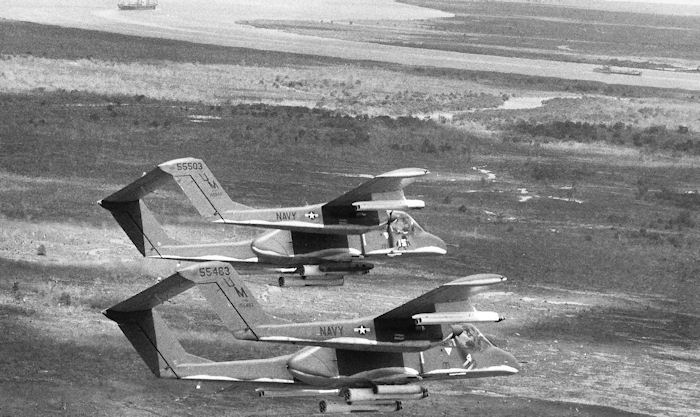
Black Pony 15 (top) on patrol with Black Pony 4 near the Long Tau Shipping Channel
A few weeks later recovery crews returned with boats, pumps, digging equipment, and shoring material. Army recovery experts accompanied the Black Ponies and Vietnamese Rangers. An Army CH-54 Tarhe helicopter tried to pull the Bronco's wing out of the mud but the cable snapped. Everyone knew the pilot's and the observer's bodies were down there, in the mud. Everyone knew how important it was to recover them. The mud, the tide, the weather, sickly fumes, all conspired to defeat the best efforts of the recovery team. When it became apparent that recovery would be virtually impossible, the pressure built. No one wanted to give up. And in the back of everyone's mind was the knowledge that families and loved ones might forever be condemned to that doubt that would always exist about those classified as missing in action. Through nausea and fatigue, injuries and tears, the men raced against the clock and the elements.
You were in mud and jet fuel up to your waist... digging and working the shoring material, plywood and stuff. We brought in pumps to pump out the mud and water... but to no avail. A boatswain's mate we called "Boats" had stuck a probe into the mud.... He found something that wasn't hard but it wasn't soft either.... There was something there, so we concentrated our efforts on that area. After a while we had some escaping smells ... that came up out of the ground, so we knew we were in the right area. The Vietnamese Rangers passed around eucalyptus oil for us to rub under our noses... they were quite a bit smarter on these matters than we were. It ended up being a bucket brigade of helmets just scooping out mud as we got deeper and deeper....
Finally we got down to the top of the seat... and as the ejection seat mechanic, an aviation structural mechanic (safety equipment) 3d class, my position was at the bottom of the hole. We got to the pilot's helmet - Joel Sandberg - first.... it had his name on it. Eventually we got down to just below his neck.... We couldn't get any farther with the mud coming in and the fuselage of the aircraft in the way.... So they decided .... the army recovery guys ... that they needed the head for positive I.D ... so I had to cut it off.... We passed it up to someone who put it in a body bag.
AME3 Bob Peetz, Black Pony

On 20 December 1969, Captain Carl E. Long (USMC) and Lieutenant Junior Grade Joel A. Sandberg (USN) were the crew aboard an OV10 aircraft (Serial Number 155503) which crashed in the vicinity of grid coordinates YS252610, approximately 12 kilometers west of Phuoc Le, Dong Nai Province. In January 1970, a search team recovered partial remains which were identified as LTJG Sandberg. In March, 1970, another search team returned to the crash site but was unable to locate the wreckage.
On 8 September 1992, a joint team visited Hoi Bai Village (YS284626), Chau Thanh District, Ba Ria-Vung Tau Province, to interview local residents regarding the recovery of alleged U.S. remains at a nearby crash site. Two witnesses reported they recovered remains and an identification card from a crash site which were turned over to province officials in February 1987. One witness produced a receipt indicating Mr. Hung of the Interrogation Section of the Dong Nai Province Public Security Office had acknowledged receipt of the remains and a wallet. The two witnesses provided the team additional bone fragments and other material evidence correlating Captain Long reportedly recovered from the same site. A third witness provided a firsthand account of a UH-10 aircraft that crashed into a nearby marshy area sometime during 1969.
On 14 December 1992, the Vietnamese Government repatriated the remains believed to be associated with this case. The remains are currently under analysis by the Central Identification Laboratory.
The case in question was the crash site of U.S. Marine Corps Capt. Carl Edwin Long, from Dallas and the Texas A&M class of 1966.
The sheer vastness of the Mekong mangrove swamp struck me as we flew low above the snarled trees; it was a steaming wet, ominous version of western Thua Thien-Hue province. The case in Question was the crash site of U.S. Marine Corps Capt. Carl Edwin Long, from Dallas and the Texas A&M class of 1966.
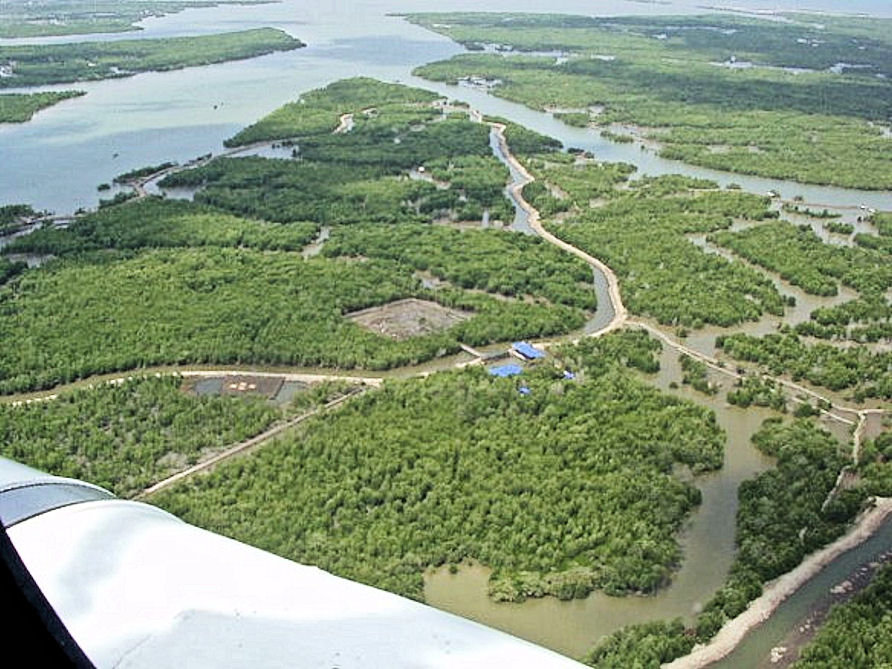
Small square left side is helo LZ, large square center is cleared site, blue tarps are screening station and pump station.
On December 20, 1969, Captain Long and USN Lt. (jg) Joel A. Sandberg were flying a propeller-driven OV- 10 Bronco out of Vung Tau as part of the U.S. Navy Light Attack Squadron Four (VAL-4), "Black Ponies" Rung Sat special patrol, to spot Viet Cong positions in the delta. Long was checking out a suspicious sampan in the Long Tau shipping channel when his wing-man reported he had lost radio contact with Long. Long's aircraft was spotted in the swamp, and an attempt was made to hook it to a CH-47 Chinook helicopter. Unfortunately, the lifting strap broke, and the aircraft sank into the morass before Long's body could be pulled from the cockpit.
Black Pony 15 (top) on patrol with Black Pony 4 near the Long Tau Shipping Channel
Thirty-four years later the investigative team questioned a shrimp farmer who was raising shrimp in a canal near the reported crash site. The farmer said he had been living there for only twenty years and knew nothing of the crash. However, he mentioned a place out in the mangrove, where the undergrowth was not very thick, and oil bubbled up to the surface. Buddy, Steve Hawley, my predecessor, and Dr. Pete Miller, a wet-site specialist, took a boat and then canoes to the site and decided the dig was just about feasible.

Site Exploration
Miller and his team, led by Capt. Geoff Kent, and about two hundred Vietnamese workers spent seventy-one days clearing vegetation, building two square coffer dams, one inside the other, draining the site into the delta and well away from the shrimp farm to avoid environmental issues with the farmer. They constructed a bamboo bridge several hundred feet long from the site to the only dry ground available, the ten-foot-wide banks of the canal, where they set up the work and screening stations. It was a task of monumental proportions in an incredibly unforgiving environment. I was simply astonished the first time I saw it.

Cofferdams
The MI-8 gingerly set its wheels on three small, wooden platforms rising out of the muck. As we hopped out, we were met by a smiling Captain Kent, who greeted us with "Sir, we got the gold." Crossing the rickety bamboo bridge to the coffer dams, I could see in the wide, deep pit pieces of wing, engines with bent propeller blades, rocket pods, and scattered aircraft parts. The team had dug about twelve feet below the original surface with a series of stairstep levels shorn up by the strong marine plywood we had imported from Hawaii. Cave-in was a constant danger.
Knowing that I had gone to graduate school at Texas A&M and that many of my family members were Aggies, Geoff held out his closed fist and said, "Here you go, sir. Gig 'em!" He then dropped Carl Long's Class of '66 ring in my palm. I held the ring for a long time, wanting to get on my cell phone and call Long's parents, as well as Col. Sam Hawes, my oldest army and Aggie buddy, but I could not tell anyone. The news had to be kept a complete secret until the official ID was made at the CIL-HI lab and the Marine Corps had notified the family. I held the ring a long while and then walked off down the canal path so the others would not see my tears.
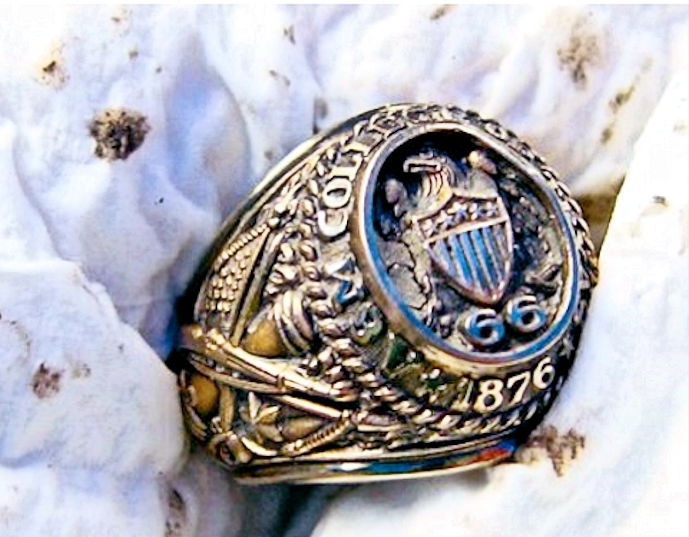
“The Thing He Carried” that was instrumental in identifying Carl’s remains.
From:‘The Flying Black Ponies’ by Kit Lavell: The day after the partial recovery of the pilot’s remains, it was decided that any further attempts to recover Carl’s remains would end due to weather, crash site conditions and enemy activity in the area. ~ It would be almost three decades before the Rung Sat would allow closure for Carl.
Carl's remains were recovered on December 16, 1992 and were identified on May 3, 2004.
Captain Carl Edwin Long was finally laid to rest at Arlington National Cemetery within sight of the Air Force Memorial in Section 68 – Site 50 on September 16, 2004
His name appears on Panel 15 West ~ Line 73 of the Vietnam Veterans Memorial “Wall”

WebKeeper's Note: In 2018 I contacted U.S. Army Col. Ty Smith (Ret.) who was the Commander of the Recovery Team. I asked him if they had recovered any of Joel Sandberg's remains. He stated that when they did the recovery of Capt. Long (JFTA Case 1538) near Vung Tau the only information they had about Lt.jg Sandberg was that he was recovered from the aircraft but Capt. Long was not, therefore only Capt. Long was listed as MIA. he said that my letter to him had indicated that we had only recovered Lt.jg sandberg's head, but not the remainder of his body.The recovery team had no idea if portions of the remainder of Lt.jg Sandberg were also recovered along with Capt. Long. The remains would have been sorted out at the Central Identification Lab in Hawaii. He Col. Smith never received information concerning the final bone analysis.
See also: Wikkipedia: Rung Sat Special Zone
Carl Long ~ Wall Of Faces
Of Special Note ~ in 2014, Emily T at Westlake High School was assigned to create a video in memory of Carl. Here is her:
Carl Long Memorial Video

Email: Additions/Comments
Page Re-Created: August 2026 By Sea'N'aiR
| 